
Daisies
with snow still on the ground

Here’s one I dug out of the early files, one that maybe deserves to see the light of day. You know how it is—some poems don’t fit in a book exactly, and they end up by the wayside. Like these daisies.
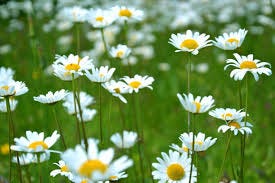
Daisies

This flowering left by the mowers, these white petals
wheeling around their yellow eyes, breeze-bent:
it’s easy to turn on the sentiment, but no matter

which petal you land on, he may love you and hate you
simultaneously. The daisy has no interest in your
childhood, your touching childish efforts to cheer,

your bouquets ripped up by the roots. It is empty
of any responsibility to end on the right petal. It is
empty of any responsibility to decorate midsummer.

Likewise, it is empty of the mists of morning and
the soft thud of deer hooves in evening. It has no need
of rhyme or any other holy thing. It does not reject

its own death; indeed, it would be lost without it.
Sin, too, and redemption: sun and rain—why use
fancy words?  Why exercise enthusiasm? To be alive

doesn’t require enthusiasm, but simply an adherence
to format, a multiplication and differentiation
of cells. So, you’re walking along, picking daisies:

have you lost a lover or gained one? Are you sad
to be growing old, to be stiffer, less energetic? Who
am I talking to?  It’s only me. When I think of Whitman

and Dickinson, even Swinburne, I think how futile
to keep my own words coming day after day, with
the family clamoring for attention, declaring

that only I can fill the void in their lives. Or is it me,
thinking I’m the answer to everybody’s prayer, the one
with the recipe for Elegant Chicken Casserole?

Still, I pick a large bouquet, bring it home, shake off
the ants, put it in a teapot, this art no worse
than any other It says “I love you,” in a Hallmark

kind of way that at least is understood by most,
a gesture in a field of hopeful gestures.
Another gem from the master. Thank you Fleda.
Beautiful, Fleda... as I always expect. You never disappoint.